
I want to tell you about the specific anxiety of hearing an unfamiliar noise outside at 11pm and having absolutely no way to know what it is.
Not a loud noise. Not the kind of noise that makes you call anyone. Just a sound — something scraping, maybe someone walking too close to the side of the house, possibly a raccoon having a very determined evening. The kind of sound where you spend a few minutes in bed doing the mental math of “probably nothing” versus “but what if” before you either fall back asleep or do something embarrassing like check the front door with your phone flashlight.
I have a camera on my back porch now. The sound happened again last month. I checked the app, saw a raccoon the size of a small dog investigating my recycling bins, and went back to sleep immediately. That is the entire value proposition of an outdoor security camera for most people. Not stopping crime. Just replacing anxious uncertainty with actual information.
The Blink Outdoor 4 is around $80 for a single camera. It runs on two standard AA lithium batteries for approximately two years between changes. You don’t pay a monthly subscription if you don’t want to. That combination — low price, no battery anxiety, no ongoing cost — is either exactly what you need or a list of compromises you’re not willing to make, depending on who you are.
What Blink is and where it sits in the market
Amazon bought Blink in 2017, same year it bought Ring, and has positioned them as the budget and mid-range rungs of its home security ladder respectively. Blink cameras cost less, feature fewer AI-powered detection features, and prioritize battery life above everything else. Ring cameras cost more, do more, and require a subscription to store footage.
The Blink Outdoor 4 is the current outdoor camera in Blink’s lineup: 1080p HD resolution, infrared night vision with an additional spotlight for motion-triggered illumination, 1-second clip pre-roll so you see what happened just before the motion triggered, PIR motion detection, two-way audio, and IP65 weather resistance. It pairs with the Blink Sync Module 2 — a small hub you plug into your router — which connects up to 10 cameras and handles communication between the cameras and the cloud or a local USB drive. Buy Blink Outdoor 4 from Amazon https://amzn.to/4wPLfUi
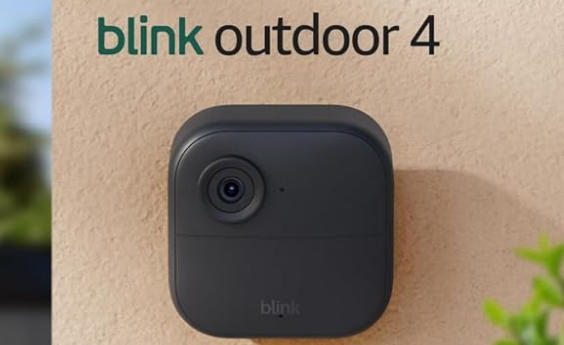
The key practical specification: two AA lithium batteries, approximately two years of life under typical conditions (defined as 40-50 motion events per day). At a high-traffic location like a front door facing a busy street, real-world battery life drops to 6-12 months. Still competitive with cameras that need periodic plug-in charging. For a back corner of a yard that sees occasional motion, two years is genuinely achievable.
The storage situation, because it’s the decision that matters most
Every security camera conversation eventually arrives at the same question: where does the footage go and what does it cost?
Blink gives you three options, which is more honest than most competitors.
The free tier gives you live view only — you can see what the camera sees right now, but no clips are saved. This is less useful than it sounds for actual security purposes, since most events you’d care about happen while you’re not actively watching, but it’s technically functional and costs nothing.
The Blink Subscription plan runs at around $3/month per camera or about $10/month for unlimited cameras. This stores 60 days of motion clips in the cloud. If you have one camera, the per-camera rate is reasonable. If you have four cameras, the unlimited plan makes more sense at $10/month flat.
The genuinely interesting option: the Sync Module 2 (sold separately, around $35) plus any USB flash drive gives you local storage with no ongoing fees. Motion clips save directly to the drive. You access them through the Blink app. No cloud, no subscription, no monthly bill ever. This is relatively rare in the consumer security camera market, where most competitors have either eliminated local storage or made it deliberately inconvenient, and it’s the reason Blink occupies a specific niche that competitors haven’t displaced.
The catches with local storage: the USB drive has to stay plugged into the Sync Module, which has to stay plugged into power and your router. If someone breaks in and takes the Sync Module, the footage is gone. Cloud storage survives that scenario; local storage doesn’t. For most people’s actual security concerns — package theft, car vandalism, who rang the doorbell at 2am — local storage is perfectly adequate. For people who feel they have genuine adversarial risk, cloud storage is the correct answer.
The image quality conversation
1080p is the Outdoor 4’s resolution, and I want to be direct: this is adequate for identification at close range and noticeably limited at longer distances.
At 10-15 feet, in daylight, 1080p produces footage clear enough to identify a person’s face, read a package label, or make out a license plate if the camera is positioned well. This covers front porch and side entrance situations.
At 25-40 feet — a driveway, a yard perimeter, a parking spot — 1080p captures motion and general shapes but loses the detail that makes footage actionable. A figure at 35 feet at night, even with the spotlight, will show you someone was there but may not show you who.
Wyze’s Cam OG at around $30-35 offers 2.5K resolution and is genuinely sharper in daylight. Arlo’s Essential Outdoor 2K at around $100 steps up further. If the distance between your camera and the area you’re monitoring is significant, resolution matters more than battery life and the Blink starts losing the comparison.
Night vision quality is serviceable with infrared — black and white, decent range — and the motion-triggered spotlight improves it noticeably in color for the duration of the clip. The spotlight is not floodlight-bright; it illuminates the immediate area well rather than washing a large zone. For porch monitoring, it’s enough. For monitoring a 30-foot driveway end to end, it’s not.
The comparison that actually helps
| Blink Outdoor 4 | Wyze Cam OG Outdoor | Arlo Essential XL Outdoor | Ring Spotlight Cam | |
|---|---|---|---|---|
| Approx. price | ~$80 | ~$50 | ~$100–130 | ~$150–200 |
| Resolution | 1080p | 2.5K | 2K | 1080p |
| Power | 2× AA battery | 1× AA battery | Rechargeable pack | Battery or wired |
| Battery life | ~2 years | ~3–6 months | ~3–6 months | ~6 months |
| Night vision | IR + spotlight | Color night vision | Color night vision | IR + spotlight |
| Local storage | Yes (USB via Sync Module 2) | Yes (microSD in camera) | Limited | No |
| Subscription needed | No (local) / ~$3–10/mo (cloud) | No (local) / ~$2/mo (cloud) | Yes (~$5–18/mo) | Yes (~$5–10/mo) |
| Apple HomeKit | No | No | Yes | No |
| Weather rating | IP65 | IP65 | IP65 | IP55 |
| Best for | Low-maintenance, subscription-free | Budget with better video | HomeKit homes | Amazon/Ring ecosystem |
The Wyze Cam OG Outdoor at around $50 is worth pausing on. It’s cheaper, has better resolution, includes color night vision (a meaningful advantage over Blink’s infrared), stores to a microSD card in the camera itself, and has a free 14-day cloud storage tier that doesn’t require a hub device. Why would anyone choose Blink over it?
Battery life. The Wyze outdoor model gets 3-6 months; Blink gets two years. That difference is real and persistent. If you mount cameras in locations where battery changing is inconvenient — a second-story soffit, a tall fence post, a spot that requires a ladder — six months versus two years changes the maintenance burden significantly. In accessible spots, Wyze is compelling. In awkward spots, Blink’s longevity earns its higher price.
The privacy note about Wyze: in 2024, a server error exposed footage from thousands of Wyze cameras to the wrong users for a brief period. This happened twice in two years. Wyze handled both incidents poorly. Blink has had no comparable incidents since Amazon’s acquisition. This doesn’t mean Wyze is inherently unsafe or that Blink is inherently trustworthy — all cloud-connected cameras carry risk — but the track record matters and Wyze’s is worse. If that kind of incident would genuinely bother you, it’s worth factoring in.
Arlo is the quality leader in this tier. Color night vision, 2K resolution, and solid AI person/package detection in the app are meaningful advantages. The Arlo subscription is more expensive than Blink’s, the battery needs changing every 3-6 months, and the cameras cost more upfront. If you want the best image quality and most sophisticated detection, Arlo is where the market points. If you want the lowest ongoing maintenance and cost, Blink is.
The setup experience
The Blink Sync Module 2 is a small square device about the size of a large deck of cards. You plug it in, open the Blink app, follow the prompts. Each camera adds with a QR code scan. I’ve set up three Blink cameras in an afternoon and the process was uneventful in exactly the way you want tech setup to be uneventful.
Camera placement requires some thought: Blink uses passive infrared (PIR) motion detection, which detects movement by sensing heat differences. This means a person walking toward the camera triggers it less reliably than a person walking across the camera’s field of view. Mount cameras at an angle to the path of likely motion rather than pointing directly at the approach. This is in the installation guide and most people skip the installation guide.
The cameras mount with a single screw, have a ball joint adjustment for aiming, and the housing is compact enough that they’re unobtrusive. The all-white design is more visible than I’d like in some placements, but Blink doesn’t make darker color options.
Motion sensitivity and clip length are adjustable in the app. The default motion sensitivity is reasonable. Default clip length is around 5 seconds, which is sometimes too short to capture the full context of an event. I run mine at 30-second clip length, which eats more storage but is worth it.
The real question
Security cameras exist at the intersection of genuine utility and mild paranoia, and the balance point is different for everyone. A camera on the front door of an urban townhouse serves a different purpose than a camera monitoring a large rural property, and the requirements are different even though the hardware might be similar.
The Blink Outdoor 4 is built for people who want cameras as peace of mind rather than as a serious security infrastructure. Low price, minimal maintenance, optional subscription, functional rather than excellent video quality. If you’re the kind of person who would check an app once when you hear something suspicious and then go back to sleep satisfied, Blink delivers that experience well and cheaply.
If you’re installing cameras because you have a specific, active security concern — a neighborhood with package theft, a property with history of vandalism, a situation where you might genuinely need footage to provide to law enforcement — the image quality and storage reliability of Arlo or Ring are worth the premium. Blink’s 1080p at distance and local-storage-on-a-USB-drive architecture are adequate for peace of mind; they’re less adequate for evidentiary purposes.
My back porch camera showed me a raccoon and I slept well. For what that’s worth, it’s done the job.