
It was a Tuesday afternoon, perfectly ordinary, when the power went out.
I was mid-sentence in a document, laptop on battery, phone at 23%. The internet went with it because my router needs power too, which I know is obvious but hadn’t actually thought through until that exact moment. I had a work call in forty minutes. I had no idea when the power would come back. My neighbor knocked to ask if my electricity was also out, which confirmed it wasn’t just me, and then we both stood there for a beat too long before going back inside to figure out what to do.
What I did was hunt for every charging cable I owned and calculate whether I could make it to a coffee shop in time. What I should have had was a portable power station sitting under my desk, fully charged, waiting for exactly this situation.
I bought a Jackery Explorer 300 Plus three weeks after that afternoon. It has sat under my desk for eight months. The power has gone out once since then — briefly, barely an hour — and I felt something I can only describe as prepared. It’s a strange feeling, being prepared for something. I don’t think I’ve experienced it often enough.
What this product category is, because most people don’t know it exists
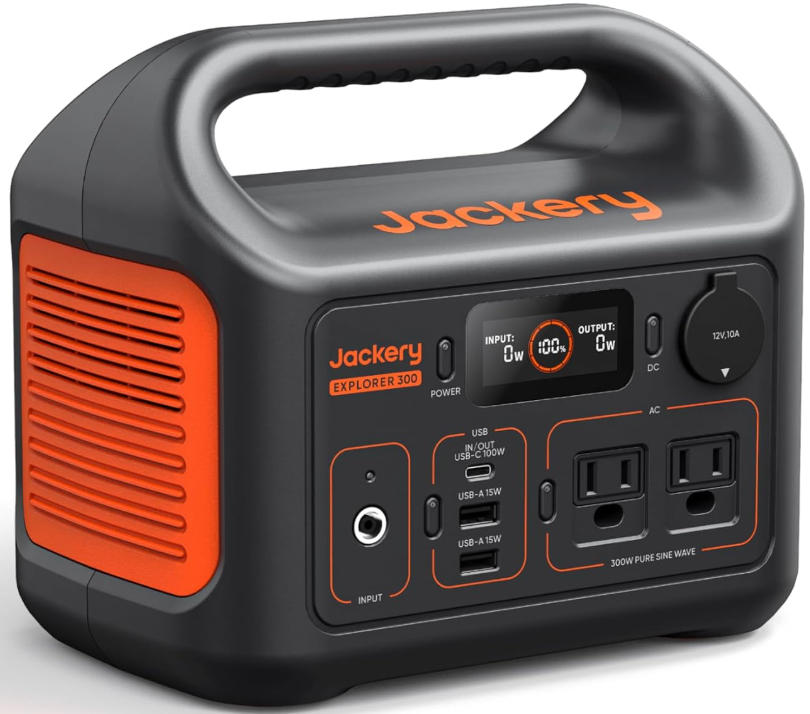
A portable power station is not a power bank. Your phone’s power bank stores maybe 20,000mAh and outputs through USB ports. A portable power station stores energy in watt-hours — the Jackery 300 Plus holds 288Wh — and outputs through actual AC outlets, the same kind that are in your wall. You can plug a laptop charger into it. A CPAP machine. A small fan. A router. Anything that draws under its 300W continuous output limit, which is most consumer electronics except things with heating elements like hair dryers or space heaters. Buy Jackery Portable Power Station Explorer 300
The category expanded rapidly after the 2021 Texas freeze and subsequent regional power events that reminded a lot of people how fragile their electricity supply actually is. Jackery is the brand that built early market share on Amazon and held it. EcoFlow and Anker caught up with competitive products. Goal Zero has been around longer but at higher prices. In 2026, all four make good products and the decision between them is closer than it’s ever been.
The Jackery Explorer 300 Plus specifically
288Wh capacity. 300W continuous AC output, 600W surge. LFP (lithium iron phosphate) battery chemistry, rated for 3,000+ charge cycles, which works out to roughly ten years of use if you’re cycling it once every day or so. In practice most people cycle it far less often, which means it will outlast most of the electronics in your house.
Weight: 8.27 lbs (3.75 kg). Handle folds flat when not in use. Dimensions are roughly the size of a large hardback book stacked on its side — not pocket-sized, but legitimately grabbable with one hand and carriable in a backpack if you need to.
Ports: one 300W AC outlet, one 100W USB-C PD port, two USB-A ports (one at 12W, one at 18W), one car-style 12V DC port. The 100W USB-C handles modern laptops directly — no AC adapter needed, just the laptop’s USB-C cable. This is useful to understand because it means you can charge your laptop more efficiently through USB-C than through the AC outlet, which has its own conversion losses.
Recharging: from a wall outlet, approximately 4 to 5 hours. From an optional solar panel, varies — Jackery’s own 40W panel adds a few hours in good sunlight. Car charging works but is slow. The app connects via Bluetooth and WiFi and shows remaining charge, input/output wattage, and estimated time remaining.
One stat that matters: the 4-5 hour wall recharge time is the Jackery’s most significant disadvantage compared to its main competitors. EcoFlow’s equivalent model recharges in about one hour. Anker SOLIX C300 gets to full in roughly 1.5-2 hours. If you need to rapidly top up the unit before heading somewhere, the Jackery requires planning ahead in a way the others don’t.
What 288Wh actually gets you
This is the part every review rushes through with a chart. I’m going to be more specific because the numbers matter.
288Wh is what it stores. The actual energy delivered to your devices is lower — maybe 80-85% efficiency through the AC outlet, somewhat better through USB-C. Realistic usable capacity is roughly 240-245Wh at the device end.
With that in mind: a MacBook Air M3 (52.6Wh battery) charges from 0% to 100% roughly four times with room left over. An iPhone 15 (13.6Wh) charges more than fifteen times. A CPAP machine running at typical pressure (around 30-40W average) lasts six to eight hours — enough for one full night’s sleep. A router drawing 15W runs for about fourteen hours. A small 32-inch TV at around 40W runs for five to six hours.
What it won’t do: run a refrigerator meaningfully (even a mini fridge draws 100-200W continuously, so you’d get two to three hours at best), power a microwave, support a window AC unit, or run anything with a heating element. The 300W continuous limit is real, and most heating appliances exceed it immediately.
For the scenarios most people actually face during outages — keeping phones charged, keeping a laptop usable, keeping medical devices running overnight, keeping the router alive — 288Wh is adequate and the 300W output is sufficient. For running your house during a multi-day outage, you need something in the 1,000Wh range minimum, and a different article.
The honest comparison
| Jackery Explorer 300 Plus | EcoFlow RIVER 3 Plus | Anker SOLIX C300 | Goal Zero Yeti 200X | |
|---|---|---|---|---|
| Approx. price | ~$230–300 | ~$280–330 | ~$200–250 | ~$300–350 |
| Capacity | 288Wh | 286Wh | 288Wh | 187Wh |
| Battery chemistry | LFP | LFP | LFP | LFP |
| AC output | 300W | 600W | 300W | 200W |
| Wall recharge time | ~4–5 hrs | ~1 hr | ~1.5–2 hrs | ~5–6 hrs |
| USB-C max output | 100W | 100W | 100W | 60W |
| Weight | 8.27 lbs | 8.0 lbs | 7.7 lbs | 5.0 lbs |
| Warranty | 3 yrs (5 w/ registration) | 5 yrs auto | 5 yrs auto | 2 yrs |
| App control | Yes | Yes | Yes | No |
| Expandable capacity | No | Yes (extra battery) | No | No |
| Best for | Emergency backup, reliability | Fast recharge, expandable | Port variety, speed | Ultralight camping |
The EcoFlow RIVER 3 Plus is the most compelling alternative. For roughly similar money, you get 600W AC output instead of 300W — which means you can run larger appliances — and the one-hour recharge is genuinely transformative. The expandable battery option is unique: you can add an extra 286Wh battery module if you need more capacity. If fast recharge is a priority for your use case, EcoFlow wins on that metric and it’s not close.
The Anker SOLIX C300 at around $200-250 is the value leader right now. LFP chemistry, five-year automatic warranty, 1.5-2 hour recharge, slightly lighter than Jackery. The port selection is arguably better — Anker tends to put more ports on their units. For someone buying their first power station primarily for emergency preparedness on a tighter budget, the C300 is the most attractive option in the comparison.
The Goal Zero Yeti 200X is the lightest option at 5 lbs and for backpackers who need every ounce to count, that matters. The 187Wh capacity and 200W output limit make it underpowered for most household emergency scenarios, and the 5-6 hour recharge is the slowest in the group. Goal Zero’s appeal is ecosystem integration — they make matching solar panels and have a loyal outdoor community — not raw value.
Why I kept the Jackery
The one-hour recharge question is legitimate and I thought about it. Here’s where I landed: for emergency preparedness use, recharge speed matters primarily when you’re trying to top up the unit from partial charge before a predicted outage, or when you’ve depleted it and power returns. In the first scenario, I keep the Jackery at full charge all the time — LFP batteries tolerate being stored at high charge far better than older lithium-ion chemistry — so I’m never scrambling to top it up. In the second scenario, a four-hour recharge versus a one-hour recharge means I’m waiting three extra hours before the unit is back to full. That’s real, but it’s also manageable.
For camping use, EcoFlow’s recharge speed matters more, especially if you’re relying on solar input and have limited good-sun hours. If camping is your primary use case, EcoFlow is the better choice and I’d say so directly.
The thing that pushed me toward Jackery was the brand familiarity in the portable power community — their customer support has a strong reputation, their firmware updates have been consistent, and eight months in, the unit has worked exactly as expected every time I’ve used it. The Explorer 300 Plus has also been available on Amazon for long enough that its real-world performance is well documented. I knew what I was getting.
Who should buy what
You want portable power mostly for home emergency backup, you’ll keep it plugged in between uses, and you’re not in a hurry: Jackery Explorer 300 Plus. Buy it, keep it charged, and forget it exists until you need it.
You need fast recharge, plan to use it for camping or trips where you’re recharging from solar during the day, or you want expandable capacity: EcoFlow RIVER 3 Plus. The one-hour wall recharge and expandable battery module are worth the slight premium.
Budget is the primary concern and you want the best automatic warranty coverage: Anker SOLIX C300. Five years automatic, solid performance, cheaper than the alternatives.
You have medical equipment that draws around 30-50W continuously, like a CPAP, and need overnight operation: any of the three main options work, but verify your device’s wattage and do the math. At 30W draw, 288Wh gives you about eight hours. That’s enough for most CPAP users on a single night with capacity to spare for phone charging. If you use heated humidification or high-pressure settings that push 60-80W, the math tightens considerably.
The power was out for just under four hours that Tuesday. I made my call from a coffee shop that was, mercifully, on a different grid section and still had electricity. I felt resourceful but also slightly foolish about the routes I’d had to take.
The Jackery under my desk is not dramatic preparation. It’s not a bunker or a generator or anything that implies I’ve thought very hard about catastrophe. It’s a device that charges while the grid is up and powers things when the grid isn’t. It weighs eight pounds and lives in the same place as my power strip.
The next time the power goes out, I will not be going to a coffee shop.