
The first time I turned on Active Noise Cancellation in a crowded subway car, I got a little scared.
Not because something went wrong. Because everything went right. One second: screeching rails, a guy arguing into his phone three seats over, the specific mechanical groan of a train that has been in service since before smartphones existed. Next second: nothing. Just my music, sitting in a perfectly upholstered bubble of silence, while the visual chaos of a packed commute continued around me with the sound turned off. Like watching a disaster movie on mute.
I stood up at my stop and walked off the train and a woman on the platform said something to me. I couldn’t tell what. I fumbled to switch modes, managed to look confused for about four seconds too long, and she repeated: “You dropped your MetroCard.”
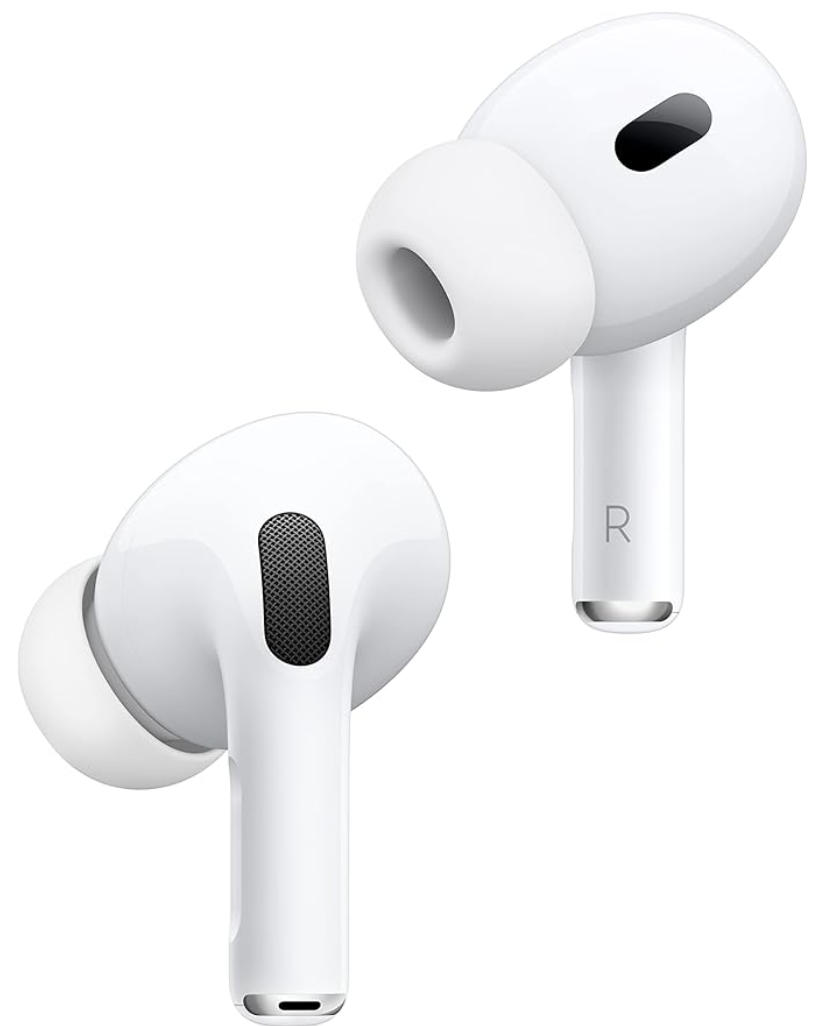
That is the AirPods Pro 2 experience in miniature. Extraordinary technology. Occasional social cost. And a feature set deep enough that most people using these daily have no idea what half of it does.
Let me fix that.
What you’re actually buying for $249
The AirPods Pro 2 run on Apple’s H2 chip, which does a few things worth understanding. It processes noise cancellation at 48,000 times per second — this number is real, it means the ANC is analyzing and responding to incoming sound faster than human perception can register. The practical result is that it doesn’t just reduce noise, it erases it with a completeness that still surprises me after a year of daily use. Low-frequency rumble — plane engines, subway cars, HVAC systems — disappears almost entirely. Human voices are reduced but not fully eliminated, which is the right call for safety.
The earbuds themselves weigh 5.3 grams each. The case with earbuds is 50.8 grams total. IP54 rating means they handle sweat and rain without drama. Six hours of battery per charge with ANC on, 30 hours total with the case — in practice this means you charge the case maybe twice a week and never really think about the earbuds themselves.
That 30-hour total number is the one that matters, not the 6-hour per-earbud figure. The earbuds live in the case when not in your ears. The case is the battery. Charge the case, and the earbuds are perpetually topped up. The only way you run out of battery is if you forget to charge the case for several consecutive days, which requires a specific kind of determined negligence.
The feature nobody talks about enough
Every AirPods Pro 2 review leads with Active Noise Cancellation. I understand why — it’s dramatic, it’s immediately impressive, and it’s the thing you can demonstrate in thirty seconds. But after a year of daily use, the feature I value most is Transparency mode, and I think this is true for most people who wear earbuds for more than two hours a day.
Here’s the situation Transparency mode solves: you want audio in your ears, but you also live in the world, where people occasionally talk to you, cars honk, your name gets called, and buildings have fire alarms. The normal solution — take the earbuds out — works fine for a brief interruption but becomes annoying when you’re in an office where someone walks by with a question every forty minutes. Pausing audio and removing an earbud fifteen times a day is a small friction that, accumulated over weeks, makes you resent the earbuds.
Transparency mode keeps audio playing while simultaneously piping in the outside world through the external microphones, processed by the H2 chip to sound natural. When it’s well-implemented — and Apple’s is the best implementation I’ve used — you forget you’re wearing earbuds at all. You’re just a person with slightly better audio awareness than usual. You can have a full conversation without touching your ears. You can hear a train announcement. You can hear your name across a room.
Conversation Awareness goes one step further: when you start speaking, the earbuds automatically lower the music and enhance the voice of whoever is in front of you. It works. It’s slightly spooky the first few times, this sensing of intent before you’ve done anything deliberate. Then it becomes invisible, which is the point.
I use Transparency mode for probably 70% of my wearing time. ANC gets the subway, flights, and focused work sessions with loud neighbors. Everything else is Transparency. This ratio is the opposite of what the marketing implies.
The hearing health features, which are genuinely not a gimmick
In October 2024, Apple released a firmware update that turned AirPods Pro 2 into FDA-authorized over-the-counter hearing aids. This landed with about a quarter of the news coverage it deserved.
Here’s what it actually does. There are three components.
The Hearing Test takes about five minutes, uses the earbuds and your iPhone, plays tones at different frequencies and volumes, and produces an audiogram — the same basic output as a clinical hearing test. Researchers at the National Acoustic Laboratories have validated the accuracy. It is not equivalent to a full audiology workup, but it is a legitimate screening tool that catches things people haven’t noticed. I took it and found out I have a minor high-frequency dip in my left ear, which explained why certain consonants had started sounding slightly unclear in noisy environments. I hadn’t been aware of this as a “problem.” The test made it visible.
The Hearing Aid feature takes your audiogram and applies customized amplification profiles to compensate for specific frequency losses. For people with mild to moderate hearing loss — a population that is enormous and massively underserved because traditional hearing aids cost $3,000 to $7,000 — this is, per audiologists who have evaluated it, the best dollar-for-value hearing aid currently on the market. At $249 for the earbuds, most of which you’re paying for everything else they do.
Hearing Protection is the quietest feature of the three but might be the most useful long-term. The H2 chip monitors environmental loudness in real time and reduces sudden loud sounds — a car horn, construction noise, a speaker that goes to sudden full volume — without affecting the overall listening experience. It is on by default in Transparency and Adaptive modes. Your ears are being protected even when you’re not thinking about it.
I want to be direct about this: if you are between 30 and 55 and you have never had your hearing tested, the AirPods Pro 2 is the easiest way to do that right now. The test result is exportable as a PDF you can share with a doctor. This is not a feature. This is a public health intervention that Apple managed to ship inside a pair of earbuds.
The things that are actually annoying
The fit system with four ear tip sizes works well but requires trying all of them to find the right one, and the in-ear seal test is slightly unreliable — it sometimes passes tips that don’t quite fit and fails ones that do. Trust your own comfort more than the test result.
Spatial Audio with head tracking is technically impressive and practically irrelevant for most people most of the time. It works in Apple TV+, some streaming apps, and certain games. The effect of audio appearing to come from the screen while you turn your head is genuinely cool for about a week, after which you stop noticing it. Not a reason to buy or not buy.
The stems. The stems of AirPods Pro are where the controls live — squeeze for play/pause and answer, double-squeeze for skip, press and hold to switch modes. This system works. It is also responsible for roughly one accidental activation per three days when the earbuds are being put in or adjusted. A small annoyance that never fully disappears.
They are iPhone earbuds. They work with Android — Bluetooth is Bluetooth — but you lose the automatic device switching, the hearing health features, the Conversation Awareness behavior, and the seamless pairing experience. If you have an Android phone and are considering these: the Sony WF-1000XM6 ($300) or the Samsung Galaxy Buds3 Pro ($230) are better matched to your ecosystem.
Who should actually buy these
If you have an iPhone and you spend more than an hour a day in earbuds: yes. At $249 — often $189 to $209 on sale, and they go on sale regularly at Amazon and Best Buy — the combination of best-in-class ANC, the best Transparency mode implementation in the market, and the hearing health suite makes this the most capable pair of earbuds for everyday life.
If you primarily want ANC for flights and commutes and don’t care about ecosystem integration: the Sony WF-1000XM6 has marginally better noise isolation in some frequency ranges and works identically across all devices. It’s a legitimate alternative without the Apple lock-in.
If you’re on a tighter budget: AirPods 4 with ANC are $179 and do most of what the Pro 2 does, minus the ear tips (which matter for isolation), the hearing health features, and the extra ear tip control. The step-down is real but not catastrophic for most users.
I still think about that subway moment sometimes. The sudden silence, the woman with the MetroCard, the four seconds of confusion. I’ve gotten better at switching modes since then. But I haven’t gotten over the strangeness of the technology — that a small piece of plastic and silicon can selectively edit your experience of reality in real time, and that this is now a thing you can buy for the price of a dinner out in a city that charges too much for dinner.
The AirPods Pro 2 are, in the clearest sense I can describe them: the best earbuds for most people, for most situations, in 2026. That’s an unsatisfying conclusion because it sounds like a press release. But it’s what I actually think after a year of wearing them six days a week, and I don’t have a more interesting take that’s also true.
The MetroCard lady, for what it’s worth, seemed unbothered.