
I want to tell you about the frozen chicken incident of 2023.
It was a Tuesday evening, 6:15pm. I had forgotten to defrost anything. The fridge contained one sad block of solid chicken breast, half a can of chickpeas, some wilted cilantro, and a level of optimism about cooking that had declined sharply since Sunday. My options were: order delivery again (third time that week, not proud), make eggs, or figure out whether the Instant Pot my sister had given me eight months earlier could handle frozen poultry.
Twenty-two minutes later I had shredded chicken in sauce over rice. The chicken had been frozen solid when it went in. I hadn’t had to watch it, stir it, adjust anything, or make a single additional decision. I texted my sister an apology for letting it sit unused for eight months and she replied “I told you.”
That is the Instant Pot Duo experience compressed into a paragraph. It does not solve cooking. It solves the part of cooking that is actually the problem: time, attention, and the specific paralysis of coming home tired and having to make decisions about things you should have prepared earlier.
What the Instant Pot Duo actually is, without the hype
The Duo 7-in-1 is a 6-quart electric pressure cooker that also functions as a slow cooker, rice cooker, steamer, sauté pan, yogurt maker, and food warmer. It has been Amazon’s best-selling kitchen appliance for years, which is either a strong endorsement or evidence that enough marketing can move anything. In this case it’s genuinely the former.
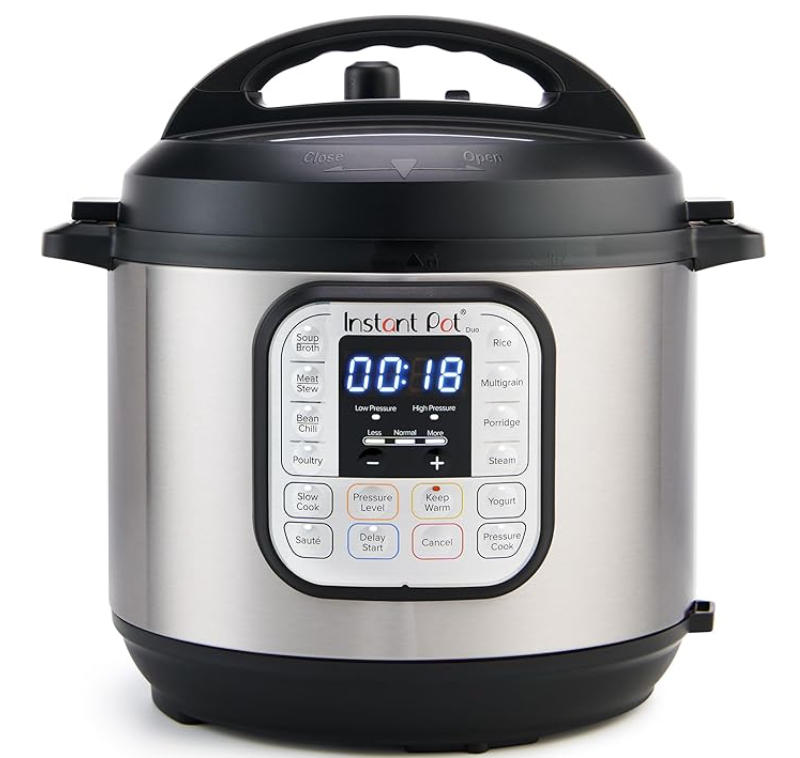
The core technology is pressure cooking — trapping steam inside a sealed pot to raise the boiling point of water above 212°F, which cooks food significantly faster than conventional methods. Dried beans that normally require an overnight soak and 90 minutes of simmering take 35 minutes from dry. A chicken breast that needs 25 minutes in the oven takes 12 minutes under pressure. Beef stew that normally simmers for two hours takes 35 minutes. These are not marketing estimates; they’re the numbers I’ve consistently gotten in my own kitchen.
The pot holds 6 quarts, which is enough for four to six servings of most things. The inner pot is stainless steel — not nonstick, which means it doesn’t scratch and doesn’t have the low-grade anxiety of wondering whether the coating is degrading into your food. The lid locks during pressurization and physically cannot be opened until the pressure has released, which is the correct answer to the question “is a pressure cooker dangerous.”
Current price: $99.99, frequently on sale for $79. This is the price point it’s been at for several years and it represents either extraordinary value or a company that has optimized manufacturing to an impressive degree.
The seven functions, and the three you’ll actually use
The Duo is marketed as seven appliances in one. This is technically accurate. Here is what that means in practice.
Pressure cooker: you will use this constantly. It’s the whole reason to own this device. High pressure, 10-12 psi, cooks up to 70% faster than conventional methods. This is the function that produces the frozen chicken outcome I described above.
Sauté: legitimately useful and underrated. You can brown meat, caramelize onions, or reduce a sauce directly in the pot before or after pressure cooking. This means one pot to wash instead of a skillet plus the pressure cooker. I sear meat in it almost every time I use it.
Slow cook: fine, works as advertised, but if you’re using the slow cook function on an Instant Pot you’ve bought a $99 Crockpot. Useful as a backup when a recipe specifically calls for slow cooking, not the primary draw.
Rice cooker: excellent. Consistently better rice than I’ve produced on the stovetop, at the right ratio of water to rice. I use this several times a week.
Steamer: works, simple, not a compelling reason to choose this over other options.
Yogurt maker: this sounds like a feature added to make the “7-in-1” claim work, and then you make yogurt in it once and realize it’s genuinely practical. You get a half-gallon of yogurt for about $2 in milk cost. I make yogurt maybe twice a month. It requires about four minutes of active effort.
Food warmer: keeps things at serving temperature. I use this when dinner is done but I’m not ready to eat yet. Rarely think about it.
The honest tally: pressure cooker, sauté, and rice cooker are the functions that justify this appliance’s existence. The others are genuinely useful bonuses, not core reasons to buy.
How it compares to the competition
This is the part most reviews handle badly — they either declare a winner without real nuance or they hedge so thoroughly the conclusion means nothing. Here’s my actual assessment:
| Instant Pot Duo 7-in-1 | Ninja Foodi 11-in-1 | Crockpot Express | |
|---|---|---|---|
| Price | $79–$99 | $199–$250 | $69–$89 |
| Pressure cooking | ✅ Excellent | ✅ Excellent | ✅ Good |
| Air frying | ❌ No | ✅ Yes (main advantage) | ❌ No |
| Sauté function | ✅ Yes | ✅ Yes | ✅ Yes |
| Inner pot material | Stainless steel | Nonstick ceramic | Nonstick |
| Capacity (standard) | 6 qt | 6.5 qt | 6 qt |
| Learning curve | Low | Medium | Low |
| Community & recipes | Enormous | Large | Moderate |
| Counter footprint | Medium | Larger | Medium |
The Ninja Foodi is the only serious rival, and the core question is whether you want an air fryer combined with your pressure cooker. If yes, the Ninja Foodi is worth the extra $120-150. Its TenderCrisp function lets you pressure cook and then crisp under the air fryer lid in the same pot — chicken that’s tender inside and crispy outside, without two appliances or two cooking sessions.
The trade-off: the Ninja Foodi is more complicated, heavier, takes up more counter space, and costs significantly more. If you already have an air fryer you like, or if air frying isn’t part of your cooking, the Instant Pot gives you 90% of the functionality at half the price. The Ninja’s inner pot is also shallower than the Instant Pot’s at the same quart rating, which matters when you’re cooking something tall — a whole chicken stands up differently in a deep pot versus a wide shallow one.
The Crockpot Express is cheaper and does the basics well. The reason I’d still choose the Instant Pot is the community: there are more Instant Pot recipes, more troubleshooting resources, and more collective knowledge than any other pressure cooker on the planet. When you’re learning, this matters. You will get stuck at some point — either because you tried to open the lid too early, or because a recipe is poorly written, or because you misread the valve position — and the Instant Pot community on Reddit and Facebook has encountered and solved essentially every problem you’ll have.
The learning curve, honestly described
There is one. It’s not steep, but it exists, and most reviews either dismiss it (“so easy to use!”) or ignore it entirely, which sets up new buyers for a specific kind of disappointment.
The valve. Every Instant Pot has a pressure release valve that sits on top of the lid. It has two positions: sealing (pressure builds up inside) and venting (steam releases). You will forget to set it to sealing at least once and then wonder why the pot isn’t pressurizing. This is universal. It happens to everyone. You set a 30-minute pressure cook, come back, and find the pot has been sitting there for 20 minutes doing nothing because you left the valve on venting. You are not uniquely bad at this. It just takes a few uses to become automatic.
The pressurizing time is not cooking time. When a recipe says “cook on high pressure for 15 minutes,” that’s 15 minutes after the pot reaches pressure, which takes an additional 10-15 minutes depending on how full it is and how cold the contents are. So a 15-minute recipe is actually 25-30 minutes start to finish. Most recipes don’t mention this prominently. Now you know.
Natural release versus quick release. After cooking, pressure can release naturally (you wait, the float valve drops on its own, usually 15-25 minutes) or you can manually turn the valve to venting for a quick release. Soups and beans prefer natural release — quick releasing sends liquid shooting through the valve and makes a mess. Chicken and vegetables are fine with quick release. The recipe will usually specify, but when it doesn’t, use the conservative option and release naturally.
After three or four uses, all of this becomes second nature and you stop thinking about it. The first three or four uses require reading the manual, which is 12 pages and takes 15 minutes.
The size question
The Duo comes in 3-quart, 6-quart, and 8-quart. Nearly everyone should buy the 6-quart.
The 3-quart is for people who live alone in a small space and never want leftovers. It’s physically smaller and the recipe selection is dramatically more limited, since most Instant Pot recipes are written for 6-quart. You will constantly be halving recipes and adjusting cooking times, which erases most of the convenience.
The 8-quart is for people with large families who batch-cook regularly. It’s physically larger, more expensive, and takes longer to reach pressure because of the greater volume. Unless you’re consistently cooking for 6 or more people, the 6-quart has enough headroom.
I use the 6-quart to cook for two people with intentional leftovers. The pot is about two-thirds full for most things I make, which is the correct zone.
The meals that convinced me to keep it
Frozen chicken to shredded meat: 22 minutes, no thawing required. This alone justifies the counter space.
Dried chickpeas to tender: 45 minutes, no soaking. I make hummus from scratch now because it’s faster than driving to the store.
Beef stew with root vegetables: 35 minutes on pressure versus 2+ hours on the stovetop, and I cannot tell the difference in the result.
Risotto: 6 minutes under pressure, zero stirring. Traditional risotto requires standing at the stove for 25-30 minutes of constant movement. I make it on a Tuesday now.
Hard boiled eggs with shells that actually peel: 5 minutes on low pressure, ice bath, done. These are the only reliably easy-peel hard boiled eggs I’ve ever produced.
Rice: 3 minutes on high pressure. Better than anything I’ve managed in a pot.
Who should not buy this
If you love the meditative process of cooking — the stirring, the monitoring, the series of small adjustments that make a dish yours — the Instant Pot will irritate you. You put things in, you close it, you wait. There’s no interaction during the cooking process. It’s like the robot vacuum of kitchens.
If your kitchen counter has no room, the footprint is real — about the size of a large stockpot, plus clearance above for the steam to vent.
If you want crispy things frequently: get the Ninja Foodi or keep your air fryer. The Instant Pot produces tender and moist. It does not produce crispy.
If you cook for one and don’t want leftovers: the 6-quart minimum is more than you need for most single-person meals. The 3-quart works but limits your recipe options significantly.
The Instant Pot Duo has been my most-used kitchen appliance for two and a half years. It didn’t make me a better cook. It made me a more consistent cook, which is actually more useful — the kind of person who produces adequate dinner from whatever is available rather than the kind of person who orders delivery because defrosting is too much to contemplate at 6:15 on a Tuesday.
That frozen chicken cost me around $4. The delivery order I would have placed cost $23 plus tip. The Instant Pot paid for itself in about two months of substituted delivery orders, and it’s been in profit ever since.
My sister was right. I should have listened sooner.