
My mother called me last November asking whether she should get an Apple Watch. Specifically, she’d seen an ad where someone’s watch detected atrial fibrillation and called an ambulance and she wanted to know if hers could do that. I told her yes, sort of, and then spent twenty minutes explaining that no, it wouldn’t automatically call anyone, it would just show her a notification she’d need to act on herself, and yes she still needed an iPhone for it to work, no it wouldn’t pair with her Android, yes she’d need to replace the phone too.
That conversation is basically this entire article. The Apple Watch is genuinely impressive. It is also a product that generates a very specific kind of confusion in people who haven’t used one before, and that confusion usually costs them either money or disappointment. Let me try to head that off.
What it actually does day-to-day
Here’s the thing nobody leads with in Apple Watch reviews: the most useful thing it does is let you not look at your phone.
That sounds small until you’ve lived with it for a week. A notification buzzes your wrist, you glance down for a half-second, it’s not important, you move on. No unlocking the phone, no accidentally opening Instagram, no twenty-minute sinkhole. I tracked this once — I check my phone about 60 times a day when I’m not wearing the watch. With it on, it drops to around 35. Those 25 interruptions just… stop happening. Which sounds like a minor quality of life thing until you realize how much of your day evaporates into that particular drain.
Beyond that: Apple Pay from your wrist works everywhere contactless payment works, and it’s faster than pulling your phone out every time. Siri on the watch is genuinely useful for setting timers and reminders in the kitchen when your hands are covered in something. Workout tracking is automatic for walking, running, swimming — you don’t have to remember to start it. And the GPS is accurate enough that when I run, my route map afterward looks like my actual route, not a slightly fictional interpretation of it.
That’s the real-world value. The health features are a separate conversation.
The health tracking: genuinely useful, but not what the ads suggest
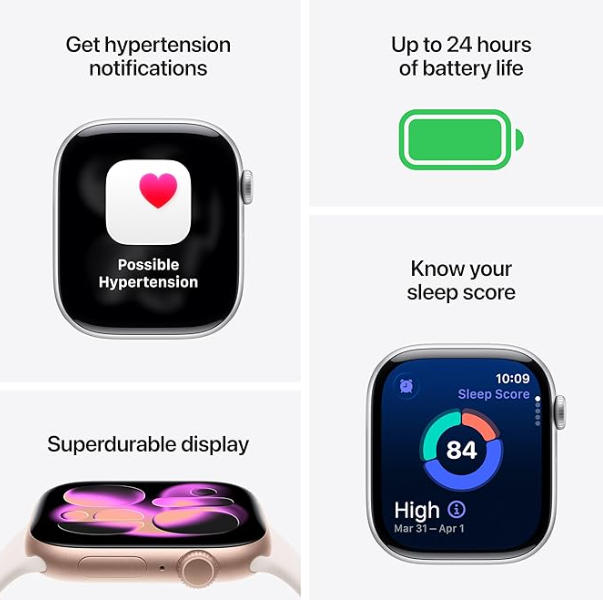
The Series 11 (launched September 2025, starts at $399) can now detect signs of hypertension. It monitors your heart rate over 30-day periods and flags consistent patterns that might indicate high blood pressure, then tells you to see a doctor. This just got FDA clearance and is available in watchOS 26. It also does ECG, irregular heart rhythm notification, sleep apnea detection, blood oxygen, and crash detection.
Let me tell you what these things actually mean in practice.
The ECG is a single-lead reading — your cardiologist has a 12-lead machine that captures your heart from twelve angles. The watch’s ECG is useful for catching atrial fibrillation, and it has caught real cases in real people, some of whom found out they had a condition they didn’t know about. But it’s also thrown up readings that sent people to urgent care for what turned out to be nothing. It’s a screening tool. It is not a diagnosis.
Sleep apnea detection works similarly — it looks for breathing irregularities and flags them. I have a friend who got this notification, went to a sleep study, and found out she did have moderate sleep apnea. She’s now using a CPAP and says she feels better than she has in years. I’m mentioning this because it’s a real outcome that happened to a real person I know, not a marketing story.
Crash detection, on the other hand, I’ve accidentally triggered twice. Both times I survived, because I was doing CrossFit, not crashing a car. This is a known problem and Apple has improved the algorithm, but it still happens. You have about 30 seconds to cancel the call before it contacts emergency services, which is enough time if you’re fine and also mildly terrifying if you’re in the middle of a burpee and your phone starts calling 911.
The hypertension detection I haven’t had enough time with to say much. It requires 30 days of data to make a determination, which is the right way to do it — high blood pressure doesn’t announce itself in a single reading. If you have a family history of cardiovascular disease, this feature alone might justify the purchase.
Which one to actually buy
This is where most guides go into a table and compare specs and I stop reading. I’ll try to do it differently.
The Apple Watch SE 3 is $249. It launched in September 2025 alongside the Series 11. It does not have ECG, no blood oxygen sensor, no temperature sensor, no sleep apnea detection, no crash detection. It has fitness tracking, heart rate, GPS, Apple Pay, notifications, and crash detection — wait, no, I’m wrong, it actually does have crash detection in the SE 3, I need to double check. Yes: crash detection is present. ECG and blood oxygen are not.
If you’re buying for a kid or a teenager, or if you mostly want notifications on your wrist plus workout tracking and you are not particularly moved by the health sensor story, the SE 3 is fine. It’s significantly fine. The experience of wearing it day-to-day is nearly identical to the more expensive models. The 18-hour battery life is the same. The band ecosystem is the same. It looks nearly identical.
The Series 11 is $399 and up. This is the one most people who read review sites end up buying, and most of the time it’s the right call. The ECG and sleep apnea detection are real features with real utility, the hypertension monitoring is new and interesting, and the screen is better — wider viewing angles, easier to read in sunlight. The 24-hour battery life is a genuine upgrade over previous models. Fast charging gets you from 0% to 80% in 30 minutes, which matters because if you forget to charge it you can get enough battery in the time it takes you to shower and eat breakfast.
I’ve been wearing one for three months. The feature I use most is still the one I mentioned first — checking notifications without pulling my phone out. That’s the Series 11. I paid $399 for it. Was the extra $150 over the SE worth it? Honestly, for me, the sleep apnea detection was the deciding factor, because I snore and my partner has been making jokes about it for years that are only halfway jokes. The watch confirmed I don’t have sleep apnea, which was information I wanted and also, admittedly, slightly disappointing because I wanted a more interesting explanation for the snoring.
The Ultra 3 is $799. It’s for serious endurance athletes and people who need 36-hour battery life. It has a titanium case, a much bigger screen, a second speaker for loud environments, and dual-band GPS that’s significantly more accurate in dense urban areas or under tree cover. If you don’t know whether you need the Ultra, you don’t need the Ultra. The thing is enormous — a 49mm case is legitimately big on most wrists — and it looks like a piece of sports equipment, which is either a pro or a con depending on who you are.
The non-negotiable thing
You must have an iPhone. Not a preference — a hard requirement. Apple Watch requires iOS. It will not pair with an Android phone. It will not pair with a Windows PC. If you have a Samsung phone, the Apple Watch is not a product for you and the correct answer is the Galaxy Watch 8.
I am putting this here in bold letters because I have watched two separate people in my life buy Apple Watches as gifts for Android users and it is a specific kind of gift-giving disaster. The watch does essentially nothing without an iPhone. Keep it.
The real question
People usually ask “is the Apple Watch worth it” when they actually mean one of two things: is it worth it for the health features, or is it worth it as a generally useful gadget.
For the health features: if you’re over 40, have any family history of heart disease, care about sleep quality, or have had a doctor mention keeping an eye on your blood pressure — yes, probably. The hypertension detection and ECG aren’t doctor replacements, but they’re the kind of early-warning system that can get you into the right office before something becomes serious. My dad had an irregular heartbeat flagged by a Series 9. Turned out to be benign. But it got him to a cardiologist he hadn’t seen in four years. That’s worth something.
For general use: it depends almost entirely on how much of your life happens on a phone screen right now. If you check your phone compulsively and find it annoying, the Apple Watch will reduce that. If you’re already pretty good about your phone, the watch will be a nice gadget that you use for notifications and workouts and mostly forget is doing anything else. That’s still worth $249. Maybe not $399.
The version I’d buy in 2026 if I were starting from scratch: Series 11, 42mm, aluminum, GPS only unless you specifically need to leave your phone at home regularly. Skip the cellular model — you pay $100 more upfront and then a carrier surcharge every month, and in practice you will almost always have your phone with you. Save the money. Put it toward a nice band, because Apple’s bands are where they really extract the money from you and the aftermarket options are a third of the price and entirely decent.
Maya has worn an Apple Watch since Series 6. She currently uses a Series 11. Her crash detection has never been triggered by an actual crash, only by aggressive squatting. She has an iPhone. Prices are US retail, May 2026.