
There’s a particular kind of morning that smart scale owners know well.
You wake up, go to the bathroom, make your way to the scale. You’ve been eating reasonably, exercising, doing the things you’re supposed to do. You step on. The scale displays your weight, then your body fat percentage. The body fat percentage is higher than you expected — or higher than yesterday, for reasons you cannot explain given that you had a salad for dinner — and your morning is now subtly worse than it was thirty seconds ago. The number has no context, no asterisk, no reminder that you drank two glasses of water with dinner last night and that BIA measurements fluctuate based on hydration. It’s just there, on the LED display, quietly undermining you.
This is the experience nobody describes in the five-star reviews. And it’s the reason the most important thing I can tell you about smart scales isn’t about the Renpho specifically — it’s about what this entire category of product actually measures, versus what it claims to measure, and how you can use one without letting it ruin your Tuesday.
The Renpho ES-CS20M is about $39 and it’s the best-selling smart scale in the country. It’s genuinely good. But let’s talk about the numbers first, because understanding them changes how useful the scale is.
What bioelectrical impedance actually does, without the jargon
Every smart scale — Renpho, Withings, Eufy, Garmin, every one of them — uses a technology called bioelectrical impedance analysis, or BIA. The scale sends a tiny electrical current through your body. Fat conducts electricity poorly. Muscle and water conduct it well. Based on how easily the current travels, the scale estimates how much of you is fat versus lean tissue. Buy Smart Scales from Amazon https://amzn.to/42ToO2D
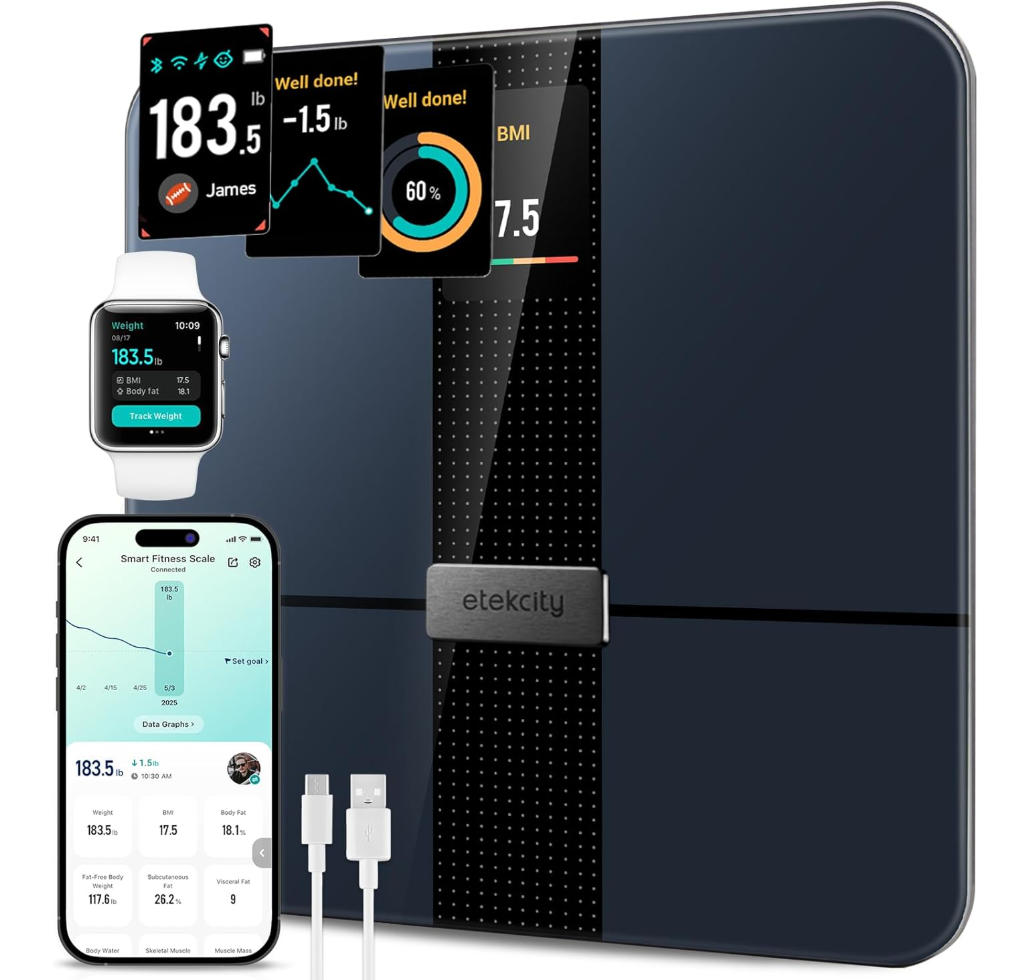
The operative word is estimates. The scale doesn’t directly measure your body fat. It measures electrical resistance, then runs that number through a prediction equation that also factors in your age, height, sex, and activity level to estimate body composition. The equation was developed by averaging results from large population studies, which means it works reasonably well in the middle of the population distribution and less well at the extremes.
In independent testing comparing smart scale readings to DEXA scans — the gold standard for body composition measurement, done in a clinical setting with expensive equipment — the Renpho consistently reads body fat percentage about 2% higher than actual. Other consumer BIA scales show similar systematic biases. This isn’t a flaw unique to Renpho; it’s an inherent limitation of consumer single-frequency BIA technology.
The other thing that moves your body fat reading around is hydration. Step on the scale dehydrated after a run and your body fat reads higher. Step on after drinking a liter of water and it reads lower. Your actual body fat hasn’t changed between these two measurements. The electrical current is traveling through more or less water.
So should you buy a smart scale that gives you body fat readings that are systematically inflated by 2% and shift with hydration? Yes, with a specific mindset shift: the number isn’t your body fat percentage. The trend is your body fat trajectory. If your body fat reading goes from 28% to 25% over four months, you almost certainly lost body fat — even if the absolute number isn’t clinically accurate. The scale is measuring the direction and magnitude of change, not the ground truth. Used this way, it’s genuinely useful. Used as a daily report card on your body composition, it produces the Tuesday morning experience I described above.
The Renpho ES-CS20M specifically
At $39, the Renpho is what you’re probably going to buy, and it’s the right call for most people. Here’s what it actually does.
Thirteen metrics: weight, BMI, body fat percentage, fat-free body weight, subcutaneous fat, visceral fat, body water percentage, skeletal muscle, muscle mass, bone mass, protein, BMR (basal metabolic rate), and metabolic age. This sounds impressive. The honest translation: weight is accurate, BMI is derived from weight and height (so also accurate), and the other eleven are estimates of varying reliability that trend meaningfully over time.
Weight accuracy is genuinely excellent — ±0.1 to 0.2 pounds repeatability in real-world testing. If you step on three times in a row, you’ll see the same number or a variation of 0.1-0.2 lbs. This is the measurement that matters most for day-to-day tracking.
The Renpho Health app is clean, well-organized, and free. No mandatory subscription for basic features. It integrates with Apple Health, Google Fit, Fitbit, Samsung Health, and Garmin Connect. The multi-user feature recognizes up to eight users automatically — it identifies you by your weight range and previous readings. In practice this works fine for a household of adults, less reliably if two people have similar weights.
Bluetooth only, no Wi-Fi. This means the scale transfers data to the app only when your phone is nearby and Bluetooth is active. If you weigh yourself with your phone in another room, it’ll ask you to sync manually later. This is a genuine inconvenience compared to Wi-Fi scales, which upload in the background automatically. How much this bothers you depends on how organized you are.
The display is an LED panel that shows your readings directly on the scale — you don’t need to open the app to see your weight. The display is clear enough to read without your glasses if you’re standing over it in normal lighting.
Battery is 3 AAA batteries, which last approximately a year of daily use.
How the competition compares
| Renpho ES-CS20M | Withings Body Smart | Eufy Smart Scale P3 | Garmin Index S2 | |
|---|---|---|---|---|
| Price | $39 | $99–$149 | $69–$89 | $149 |
| BIA technology | Single-frequency | Dual-frequency | Single-frequency | Single-frequency |
| Body fat repeatability | ±1.4% | ±0.8% | ±1.2% | ±1.3% |
| Connectivity | Bluetooth only | Wi-Fi + Bluetooth | Bluetooth | Wi-Fi + Bluetooth |
| Display on scale | Weight + basic metrics | Weight only | All metrics (3.5″ LCD) | Weight + all metrics |
| App subscription | No | No (premium optional) | No | No (Garmin Connect) |
| Users supported | Up to 8 | Up to 8 | Up to 16 | Up to 16 |
| Ecosystem integration | Apple Health, Google Fit, Fitbit, Garmin | Apple Health, Google Fit, MyFitnessPal | Apple Health, Google Fit | Garmin Connect (deep) |
| Best for | Most people | Serious health tracking | People who hate opening apps | Garmin watch users |
The Withings Body Smart at $99-149 justifies its price premium in two ways. First, dual-frequency BIA is meaningfully more accurate than single-frequency — its body fat repeatability of ±0.8% versus Renpho’s ±1.4% produces more consistent readings day to day, which matters if you’re tracking closely. Second, Wi-Fi connectivity means the scale uploads data to the app automatically even when your phone is in the kitchen. The Withings Health Mate app is also the best in class for long-term trend visualization — if you want to look at 18 months of body composition data on a single chart, Withings does it better than anyone.
Whether that’s worth $60-110 more depends on how seriously you’re tracking. For most people who want a smart scale for general wellness awareness: Renpho. For people who genuinely want to understand body composition trends with more precision over time: Withings.
The Eufy Smart Scale P3 at $69-89 has one meaningful advantage over Renpho: the display. It shows weight, body fat, and other metrics directly on the scale’s 3.5-inch LCD screen without requiring you to open an app. If you’ve ever weighed yourself, glanced at the number, and walked away without touching your phone, the Eufy is designed for you. The actual measurement quality is comparable to Renpho at roughly similar accuracy. The price premium is essentially for the better display.
The Garmin Index S2 at $149 is a one-audience product: people who wear a Garmin watch and want their weight and body composition in Garmin Connect alongside their training load, sleep data, and activity metrics. If you’re that person, it’s the obvious choice — the integration is seamless and the unified health dashboard is genuinely excellent. If you don’t have a Garmin ecosystem, the Index S2 has no meaningful advantages over Withings at a higher price.
The things I do differently since using a smart scale for two years
I weigh myself at the same time every morning, immediately after getting up and using the bathroom, before eating or drinking anything. This consistency is what makes the data useful — it removes the variables of hydration, recent meals, and time of day. The absolute number on any given morning is noise. The weekly average tells me something.
I stopped tracking body fat daily and started tracking it monthly. The daily fluctuations are hydration artifacts; the monthly trend is actual biology. A 0.5% daily variation means nothing. A 1.5% downward trend over six weeks means something.
I turned off the Renpho app’s default daily weight notifications. They were creating a relationship with a number that I don’t think was healthy. The scale is now a data collection device, not a daily verdict.
I stopped comparing my body fat percentage to charts of “healthy ranges.” The absolute number from a consumer BIA scale isn’t accurate enough to make that comparison meaningful. What I track is the direction of movement and, separately, whether I feel good and can do the physical things I want to do.
This sounds like a lot of self-talk to have done around a $39 bathroom scale. But I’ve watched people buy smart scales and become anxious about the numbers, then stop using them entirely, then feel vaguely guilty about the scale sitting on their bathroom floor for months. The scale isn’t the problem. The expectation that it’s telling you your exact body composition is the problem. Correct the expectation and the scale becomes genuinely useful.
Who should buy what
First smart scale, don’t want to overthink it: Renpho ES-CS20M, $39. Accurate weight tracking, adequate body composition trends, good app, free, works with everything. Buy it.
Want the most accurate body composition tracking available in a consumer scale and will pay for it: Withings Body Smart, $99-149. Dual-frequency BIA, Wi-Fi, best app, best long-term trend visualization.
Hate opening apps, want to see everything on the scale display: Eufy Smart Scale P3, $69-89. Large clear display shows all metrics directly. Measurement quality comparable to Renpho.
Already use a Garmin watch and want unified health data: Garmin Index S2, $149. Only worth it if you’re in the Garmin ecosystem; otherwise overpriced.
Budget is under $30: Wyze Scale X at $29. Fewer metrics, app is more basic, but weight accuracy is fine and it syncs reliably. If all you want is connected weight tracking without the body composition data, Wyze does the job.
I’ve been using the Renpho for two years. I’ve watched my weight trend down, stay flat, tick up a few pounds around the holidays, trend down again. I have a reasonable sense of my body composition direction. The body fat number still reads about 2% higher than I know it actually is, based on the one DEXA scan I had done out of curiosity, and I have made my peace with this. The number I see is consistently 2% too high, which means the trend is still accurate even if the absolute value isn’t.
Tuesday mornings are no longer ruined by the scale. Mostly because I stopped stepping on it and immediately catastrophizing about the numbers. The scale didn’t change; I did. The scale was always fine.
It’s about $39. It does what it says. Don’t ask it to tell you the truth about your body — ask it to show you the direction you’re moving, and it will do that reliably.